Cost Volume Profit Analysis Assumptions Include Which of the Following
Cost- volume-profit Analysis assumptions include which of the followingA. Costs can be classified into variable and fixed components.
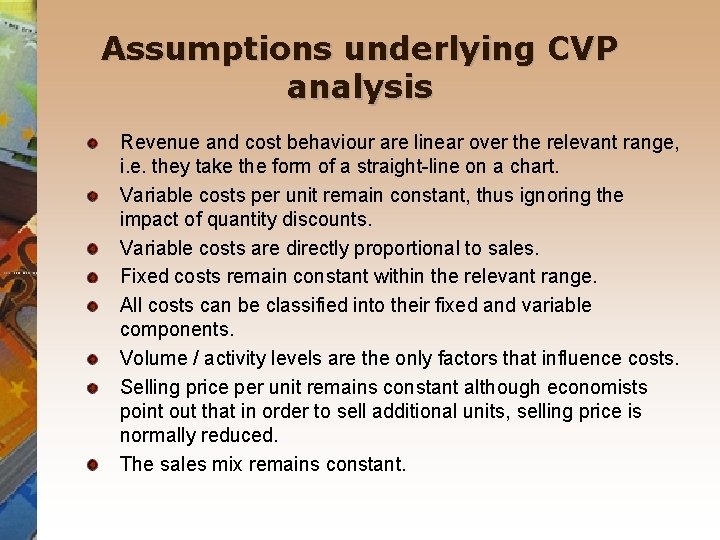
Chapter 4 Marginal Costing And Costvolumeprofit Analysis Cost
Both unit variable costs and total fixed costs remains constant.
. All units produced are sold. It is assumed that the production facilities anticipated for the purpose of cost-volume-profit analysis do not undergo any change. Selling price is constant.
All units produced are sold. Costs can be accurately separated into their variable and fixed components. B both unit variable costs and total fixed costs remain constant c Neither unit variable costs nor total fixed costs remain constant d A and B are correct e A and C are correct.
The price of a product or service will not change as volume changes. CVP analysis makes several assumptions including that the sales price fixed and variable costs per unit are constant. Total costs are directly proportional to volume over the relevant range.
The assumptions underlying the cost-volume-profit analysis are discussed below. All costs can be divided into fixed and variable elements. Changes in activity are the only factors.
The behavior of costs is curvilinear throughout the relevant range. Changes in activity are the only factors that affect costs. Total variable costs are directly proportional to volume over the relevant range.
In the case of the firm or business which sells the multiple products the sales mix will be constant. Cost-volume-profit analysis includes all of the following assumptions except a. The behavior of revenues and expenses is accurately portrayed as linear over the relevant range.
Costs can be classified accurately as either variable or fixed. All costs can be divided into fixed and variable elements. Petrol septine and tridol.
Cost-volume-profit analysis includes all of the following assumptions except the behavior of costs is curvilinear throughout the relevant range. Neither unit variable costs nor total fixed costs remain constant. Which of the following are assumptions of cost-volume-profit analysis.
Changes in activity are the only factors that affect costs. Changes in activity are the only factors. Following are the main limitations and assumptions in the cost volume profit analysis.
B Fixed costs per unit stay the same within the relevant range c Costs are linear and can be accurately divided into. These assumptions may be identified as the fundamental base of such analysis. Such analysis gives misleading results if expansion or reduction of capacity takes place.
The time value of money is incorporated in the analysis. One of the major assumptions limiting the reliability of breakeven analysis is that When used in cost-volume-profit analysis sensitivity analysis Marston Enterprises sells three chemicals. Cost-volume-profit analysis includes all of the following assumptions except.
A number of assumptions underlie cost-volume-profit CVP analysis. The behavior of costs is curvilinear throughout the relevant range. Costs can be accurately separated into their variable and fixed components.
Question 2 1 out of 1 points Chung. These cost volume profit analysis assumptions are as follows. A an B are correctE.
Question 11TCO 4 Assumptions underlying cost-volume-profit analysis include all of the following except. Costs can be classified accurately as either variable or fixed. Running a CVP analysis involves using several equations for price cost and.
This means that a company can sell more or fewer units at the same price. A Costs can be accurately seperates into their variale and fixed components. Cost-volume-profit analysis includes all of the following assumptions except a.
Cost-volume-profit analysis includes all of the following assumptions except. To summarize the most important assumptions underlying CVP analysis are. Sales price is the only relevant factor affecting costQuestion 22TCO 6 A basic.
Costs can be classified accurately as either variable or fixed. 1 out of 1 points Cost-volume-profit analysis includes all of the following assumptions except Selected Answer. Cost-volume-profit Analysis assumptions include which of the following.
The number of output units is the only driver. More Assumptions of CVP Analysis. Volume is the only relevant factor affecting cost.
Selling prices are to be unchanged. Costs can be classified accurately as either variable or fixed. Costs are linear and are designated either variable or fixed.
Costs can be classified accurately as either variable or fixed. Cost Volume Profit Analysis assumptions include which of the following. The selling price per unit will be constant and will not decrease increase grounded on volume.
Which of the following is not an assumption of cost-volume-profit analysis. The variable element is constant per unit and the fixed element is constant. 5 all costs can be divided into fixed and variable elements.
Selling prices are to be unchanged. The behavior of costs is curvilinear throughout the relevant range. Costs are linear and can be accurately divided into variable and fixed elements.
A and C are correct. Assumptions made in cost-volume-profit analysis. Selling price variable cost per unit and total fixed costs remain constant through the relevant range.
58 Cost-Volume-Profit Analysis Summary. In cases where a variety of products with. Changes in activity are the only factors that.
Check all that apply a In multi product companies the sales mix is constant. The behavior of costs is curvilinear throughout the relevant range. The technique of cost-volume-profit analysis rests on a set of assumptions.
The behavior of costs is curvilinear throughout the relevant range.
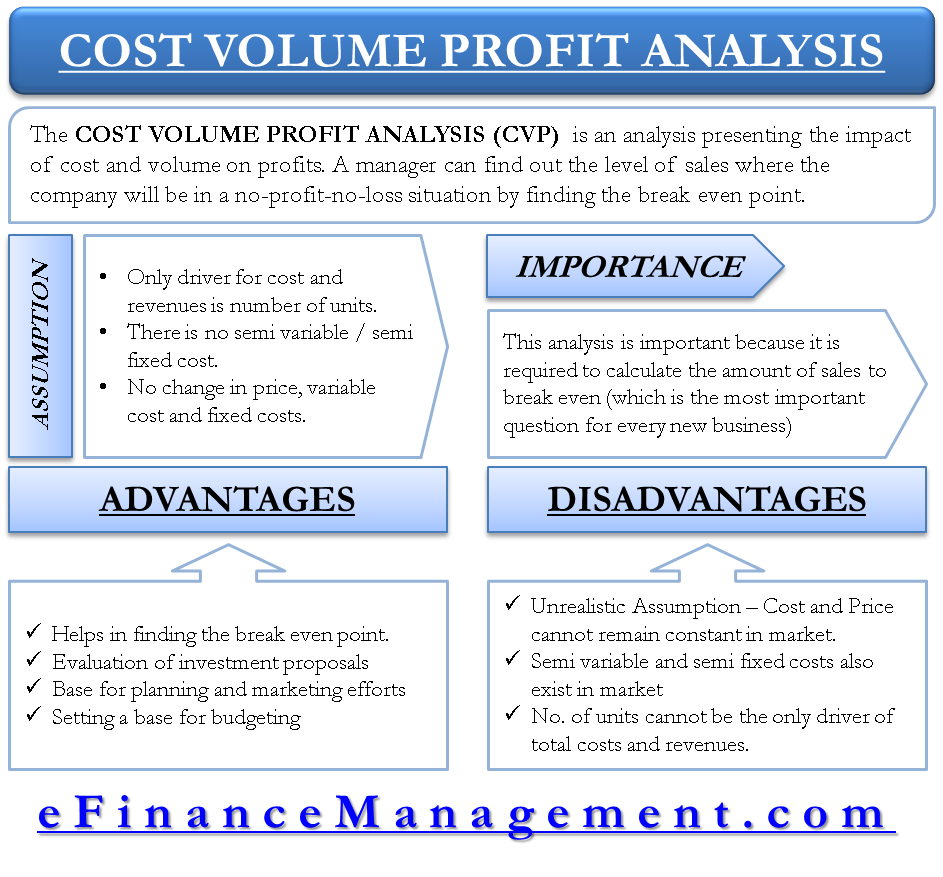
Cost Volume Profit Analysis Define Assumption Pros Cons Importance

Assumptions In Cvp Analysis Youtube

Cost Volume Profit Analysis Definition Objectives Assumptions Limitations
No comments for "Cost Volume Profit Analysis Assumptions Include Which of the Following"
Post a Comment